
The Bioinformatics CRO Newsletter
August 2026
Data to Discovery: What’s New at the BCRO
Welcome to the first edition of The Bioinformatics CRO Newsletter.
Every quarter, we’ll share recent conversations from The Bioinformatics CRO Podcast, selected publications from our bioinformaticians and collaborators, practical guidance for working with complex biological data, and examples of how bioinformatics is helping research teams move projects forward.
In this edition: clinical genomics, precision immunology, recent work across proteomics and microbial genomics, an example of bioinformatics in practice, and a practical guide to preparing project metadata.
New on The Bioinformatics CRO Podcast
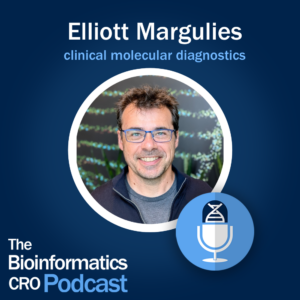
Elliott Margulies: Molecular diagnostics and clinical genomics
Elliott Margulies, Director of Bioinformatics at BillionToOne, discusses the application of molecular diagnostics to clinical testing and a career spanning genome technology, computation, and clinical translation.
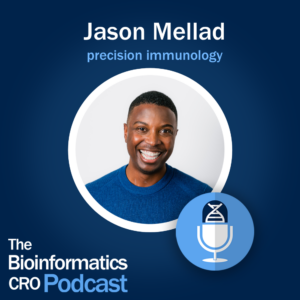
Jason Mellad: Building platforms for precision immunology
Jason Mellad, co-founder and CEO of OtoImmune, shares his vision for personalized precision immunology and explains how patient need can shape new approaches to immune and autoimmune disease.
Dr. Eric Green: The Human Genome Project and the future of genomics
Dr. Eric Green, Chief Medical Officer at Illumina and former Director of the National Human Genome Research Institute, reflects on the Human Genome Project, his time leading NHGRI, and the future of clinical genomics.

Recent Publications
Our bioinformaticians continue to contribute to research across a broad range of scientific areas.
Integrating deep learning for post-translational modification crosstalk on Hsp90 and drug binding
This 2025 Journal of Biological Chemistry study combined mass spectrometry and deep learning to investigate how patterns of post-translational modification on Hsp90 may influence ATP and inhibitor binding.
Polybacterial intracellular macromolecules shape single-cell inflammatory profiles in upper airway epithelia
Published in npj Biofilms and Microbiomes, this study examined how bacterial macromolecules within epithelial cells can shape inflammatory signaling across upper-airway mucosal sites.
The first single-cell sequencing of Plasmodiophora brassicae reveals genetic diversity and clonal dynamics
This Frontiers in Microbiology paper reported the first single-cell whole-genome sequencing of a plant pathogen and identified substantial genetic diversity within cells isolated from a single infected root.
Practical Bioinformatics Tip
Why metadata is often the most important file in your project.
Sequencing files contain the biological measurements, but the metadata determines whether those measurements can be interpreted correctly.
A well-prepared metadata file connects each sample to the information required for analysis. Depending on the project, that may include treatment group, disease status, collection time, tissue type, experimental batch, sequencing run, patient or animal identifier, and relevant clinical or experimental variables.
Incomplete or inconsistent metadata can delay a project, limit the analyses that can be performed, and make it difficult to distinguish genuine biological signals from technical variation.
Before transferring your data, we recommend:
- Using one row per sample and one column per variable
- Ensuring sample names match the sequencing files exactly
- Including experimental groups, batches, time points, and relevant covariates
- Defining abbreviations, units, and coded values
- Clearly identifying missing values
- Avoiding merged cells, hidden formulas, and colour-based annotations
A clean metadata file can save time, reduce errors, and help your bioinformatician design a more rigorous analysis from the beginning.
Stay in Touch
If we’ve worked together before, thank you. We’re grateful for the opportunity to support your science.
As your priorities evolve, we’d be glad to reconnect. That could mean scoping a new analysis, reviewing an experimental design, extending a past project, or simply talking through what may now be possible with your data