The Bioinformatics CRO Podcast
Episode 93 with Trevor Nicks
On The Bioinformatics CRO Podcast, we sit down with scientists to discuss interesting topics across biomedical research and to explore what made them who they are today.
You can listen on Spotify, Apple Podcasts, Amazon, YouTube, Pandora, and wherever you get your podcasts.
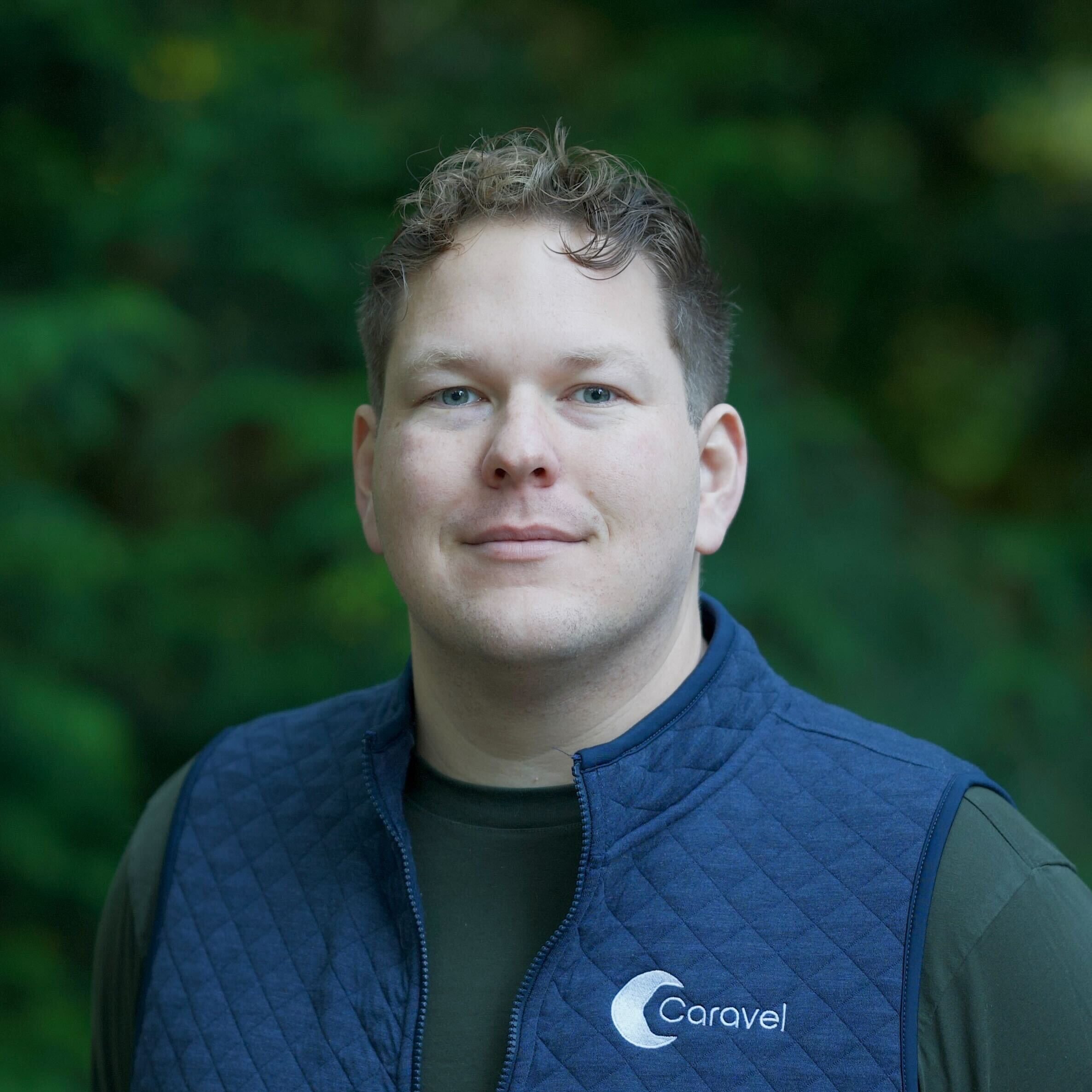
Trevor Nicks is the founder and CEO of Caravel Bio, which innovates using cell-free protein engineering.
Transcript of Episode 93: Trevor Nicks
Disclaimer: Transcripts are automated and may contain errors.
Grant Belgard: Welcome to the Bioinformatics CRO Podcast. Today, we’re speaking with Trevor Nicks, founder and CEO of Caravel Bio. Trevor is a biotechnology engineer and entrepreneur whose path has included an early algae biotechnology venture and doctoral research in chemical and biological engineering at Tufts, where he worked on bacterial spore display and protein stability for cell-free systems. Our main topic today is biological compute. One of machine learning’s early lineages, genetic algorithms, borrowed a simple loop from evolution: vary, test, select, and repeat. Trevor’s work asks what happens when that loop is not merely represented in software but made physical, using real evolutionary cycles to search for better proteins.
Grant Belgard: We’ll explore how that paradigm differs from conventional protein engineering, where machine learning fits, how it might translate into applications such as critical minerals processing and industrial separations, how Trevor arrived at this work, and the advice he would give scientists and founders pursuing unconventional paths. Trevor, welcome to the show.
Trevor Nicks: Thanks, Grant. Glad to be here
Grant Belgard: So for listeners meeting you for the first time, what are you building now and what problem are you trying to solve?
Trevor Nicks: So I’m building Caravel as a company, right? And within that Caravel is a platform, and the problem our platform solves is how do we generate data that will allow us to actually create products that work in the real world? And so we ask really important questions like how do we generate more data? How do we generate data that’s relevant to the final application and not just in proxy conditions? And how do we generate that data in a timely manner and with costs that are low enough that we can actually build products before investors or customers get impatient with us?
Grant Belgard: So what do you mean by a protein machine, and what does that phrase reveal that protein engineering does not?
Trevor Nicks: Good question. A protein machine in the way we think about it is that there are simple machines, which might be a singular protein and then there are more complex machines that might be multiple proteins or protein systems. And so at Caravel, as you said in the intro we leverage a unique piece of biology called bacterial spores. And spores have this protein shell, and then we’re engineering that shell as a carrier that can be functionalized with many different proteins or enzymes. And so when we say protein machine, we’re often talking about along this layer of singular proteins, which would be enzymes or therapeutics, all the way up to these larger protein masses that have many different pieces of protein machines upon them that are a more complex machine that can then serve a, a certain function.
Grant Belgard: When you use the phrase biological compute, what do you mean?
Trevor Nicks: Compute for us is often thinking about the idea that we need to have memory. If we’re trying to solve a problem, we need to ask how well did it go last time?” And we need to have adaptability, so thinking about what are we gonna do for the next round when we try to solve the solution in, round two or three or four or five or a hundred. And then we need to have the ability to move between those rounds very quickly. And so biological compute here for us is thinking about how are we doing evolution, what systems, like biological systems, are we using to do our memory and our adaptation but then also the layer of machine learning and computation that goes alongside our biology. So we’re not just doing biology, and we’re not just doing machine learning. It is a hybridized system where there’s a whole loop that plays together, interacts round to round.
Grant Belgard: Can you narrate one complete mutate, test, select, repeat cycle as though we were watching it happen at the bench?
Trevor Nicks: I’ll give you an example from our work on carbon capture with Shell. As I was just– as I was leaving my PhD, we started to have a good conversation with Shell through the Greentown Labs program on how could we make enzymes enable us to do carbon capture better as a society. And so there’s this idea that people have been working on for about twenty years that enzymes could allow carbon capture to be lower cost by changing the solvent that’s actually doing the capture. And an enzyme could allow us to use a lower cost solvent that requires less heat to pull the CO2 out in the end. But the same type of chemistry change that allows us to use less heat and save cost means it also absorbs CO2 slower. So could we use an enzyme to speed that up?
Trevor Nicks: People have been trying to do that for a while and there are some issues there around the industrial viability of the enzymes to actually do that job in a costly or cost-effective manner. And so the loop that we’ve created for that has been asking this question of how can we make an enzyme that lasts as long as possible in these real industrial conditions? And so because we’re using our spores, what we do is we take the spores, which have a copy of the genome inside of them, and they’re expressing an enzyme on their surface. And we make, a million different versions of those spores, and we can screen them in the actual industrial conditions because of the stability of the spores themselves. And when I say conditions, people might be thinking pH and temperature, and that’s true. But on top of that too, as importantly, is time.
Trevor Nicks: And the true phenotype that we want from these enzymes is how long do they last in a given time cycle. For this exact experiment, we’re actually relying on the ability of the spores to maintain a specific genotype-phenotype link for months on end, and so that we can ask this copy of this enzyme, how long did it last in the exact industrial conditions? And so that loop is make spores, put spores in reactor run reactor for two months. Afterwards, pull out all of those spores and ask which ones are actually still viable. And then from that, learn and repeat. So it’s a very long loop because the goal is longevity of the enzyme itself. That’s what we’re evolving for.
Grant Belgard: What sense is that cycle computing rather than iterative screening?
Trevor Nicks: The idea of compute is the memory itself, in that in traditional systems for doing approach in engineering, it would be essentially impossible to ask for a million different versions of these enzymes. How long do they last in these scaled conditions in the reactor? Because there’d be no way to maintain this genotype-phenotype link in a way that is manageable or viable. And because we’re able to maintain that memory over that long period of time, that actually allows us to do the measurement that enables the compute to then get to the next round of predictions whether that’s through random mutagenesis with a genetic algorithm or if it’s through other types of algorithms.
Grant Belgard: What parts of the search are best handled by evolution, which by machine learning and which by human judgment
Trevor Nicks: That’s a fun question. I think we are actively evaluating that for ourselves right now. I don’t know that I have a perfect answer for you. Right now, in the carbon capture work, we’ve had some really good luck with really early designs that came out of building models based off of publicly available data. And then some of our early mutation data baked into that gave us some really great enzymes just in the first six to twelve months of this work. So that was definitely a hybridized system. In other areas where we’re working, for example, in the critical minerals, we’ve tried some work to do de novo protein design for the minerals, and there’s been some luck there.
Trevor Nicks: But some of the best designs have actual- actually just come out of the fact that we have someone who has a PhD in metalloproteins, and his instincts on what the chemistry should be– And by instincts I mean he studied at UC Davis and UC Berkeley, for ten years and is very good at understanding these chemistries and how the different shells and amino acids are going to interact. And that’s given us actually better proteins thus far than any singular machine learning prediction sequence. But we are doing the combination of both and seeing if we can, in the end, create a system that enhances the abilities of people to design better proteins through physics-based modeling.
Grant Belgard: How do you design a selection pressure that rewards the property you ultimately need outside the assay?
Trevor Nicks: For our system, we love generating lots of data. And so if we can, we love to come back to what is called fluorescence-activated cell sorting or fluorescence-activated droplet sorting. And so within that is we are trying to do our best to, again, maintain the memory of what occurred in that industrial condition because the spore is going to maintain whether or not this enzyme or protein was inactivated or damaged during some given process, and then evaluate if that protein is still viable while it’s being sorted, whether that’s in a microfluidic device or in a laser-based system like FACS.
Grant Belgard: How do you distinguish transferable improvements from assay artifacts?
Trevor Nicks: Yeah, that’s a good one. We’re not always able to, right? And so it– when I say that, I mean in that we’re not always able to immediately, and then it’s oh, we learn when we want to scale up that oh, that was just the thing where they performed better in the assay. So for example, in some of our carbon capture work we did have enzymes that were effectively false positives, where they would sit in the reactor for a long period of time, and then afterwards we’d evaluate them. And there were some that were active when we were actually evaluating them after that two months. But then when we actually tested them in bulk where it’s like that pure enzyme, it didn’t actually work at the elevated temperatures and with like the other contaminants that go into the actual industrial reactions. And so we effectively learned oh, that enzyme had just refolded when we went back to test it afterwards.
Trevor Nicks: I think the answer to your question is, we always do our best to approximate the real world conditions and measure in those but there has to be a cycle of veracity where we’re funneling down. And every time we funnel, we are asking, “How does this actually work in the scaled conditions?” And we try to get to that point as fast as possible.
Grant Belgard: How do you keep a search from losing diversity or settling too early on a local optimum?
Trevor Nicks: We do a couple different things there. The first is At a high level between rounds of evolution, we’re always doing mutation. So even if we had, from our last round oh, just this one sequence dominates the population. It’s ninety-nine percent of what was enriched. We’ll take that one, and we will add back in some of the ones from the previous round while also recombobulating those together just to make sure that, we’re not just gonna get that same one again after the next round of selection. And then at the same time, we’re diversifying from that one. Now, diversifying from just the one that does mean you’re probably gonna be around that local maximum.
Trevor Nicks: But then because we’ll also recombobulate it with other ones, whether those came from nature or if those come from AI designs like de novo predictions that recombobulation on its face is giving us a broader search space than if we were just to do the evolution itself of always saying, “Okay, this is the parent. We diversify from the parent.” Because we always seed back in a few other designs, we’re getting a more expansive search space, and that’s very purposeful
Grant Belgard: Where, if anywhere, do cell-free systems change what can be explored?
Trevor Nicks: I originally really wanted to do my PhD on cell-free protein synthesis ’cause it was so cool when I was, looking at grad school that like, oh, you could express these toxic proteins or maybe you could put the, put in a non-canonical amino acid super easily. And that was really exciting. Didn’t get into any labs that were directly doing cell-free protein synthesis at the time but ended up working on this spore project which in the end has actually enabled us to do cell-free protein synthesis in really new, powerful ways by increasing throughput. And the point being that we’re using cell-free protein synthesis today to make proteins that are toxic to living cells. That’s kinda the first thing. So we’re engineering this protein where if you overexpress it in pretty much any bacteria or even mammalian cells, it kills them because it’s damaging the genome.
Trevor Nicks: But we really need that protein to work ’cause if it does work, it’s gonna allow everybody in all of biotechnology to have access to lower-cost DNA. And the fact that it enables lower-cost DNA is also why it’s toxic to express in cells, right? And that’s an example. The other thing here is I’ll circle back to, again, genetic code expansion. So that’s where we’re making systems that use amino acids that aren’t normally found in nature. To do genetic code expansion inside of a living cell is quite arduous in that it can take a lot of time to do the background work of doing the genome engineering to actually enable the use of that amino acid at a high enough level for you to actually be able to study it or use it. We are able to do cell-free protein synthesis to quickly prototype and ask the question, is it actually worth using that non-canonical amino acid in this protein?
Trevor Nicks: Does it actually make a good product? And then if it does, if the answer is yes to that question, then we can put the time and money and invest in building the strains that can make that at scale. So that’s kinda how we’re thinking about it today. It’s either making things that we couldn’t make in a cell or making things much, much faster to then actually see what we should invest in to make the full product.
Grant Belgard: What role in practice does genetic code expansion play in expanding the searchable chemistry space?
Trevor Nicks: I think it has a huge role to play, but importantly, it’s not the only thing that has a role to play. There are other systems too. But so for genetic code expansion, there are over five hundred known amino acids in the literature that people have made systems for. There are amino acids that are halogenated or have new kinds of click chemistries, which is like how people are making antibody drug conjugates. And so we’re, looking at, all those different kinds of amino acids that other people have developed and worked on, and also thinking about some new ones that can potentially enable some types of um, new chemistries that don’t exist yet in biology. But then beyond that um, other types of new chemistries, or I should say new chemistry-enabling systems or like some types of proteins that enable post-translational modifications.
Trevor Nicks: Our chief innovation officer Agneya, he did his PhD and postdoc at ETH Zurich studying these microbes that live in sponges in the ocean. And they have this entirely different system that isn’t found elsewhere for making post-translational modifications in a very targeted, specific way. And so we’re also looking at those systems to ask, can we use those to make proteins that have new chemistries? And would that actually enable those new proteins to scale better than if we were using traditional genetic code expansion? So we’re really excited about genetic code expansion, but even more importantly, we’re just asking how do we make the best chemistry? How do we make the best protein machine, if you will? And then checking out what tools exist to make that happen.
Grant Belgard: Hardest about maintaining a reliable link between sequence and measured function at very high throughput
Trevor Nicks: I think the hardest thing is one of course is like the assay to even have the throughput. But then it comes back to the question you asked earlier in terms of how do you distinguish between an artifact of your assay and what’s actually useful. And to give you a bit of an example, sometimes we’ve made enzymes that in theory, based off our ultra-high throughput assay, were extremely active and doing much, much better than any parent enzyme, like fifty X. And then we actually went and scaled that up and we learned oh, that wasn’t even relevant because the actual substrate concentration is so much higher in the scale system that change in speed didn’t even matter, right? So I would say the hardest thing about ultra-high throughput screening is making it matter in terms of having the data you produce, the new sequences you produce be relevant to the final product.
Trevor Nicks: And that’s a learning curve for almost every new protein. And so making systems that allow us to run that learning curve faster for new proteins is a big part of what Caravel is becoming in terms of making it applicable across many different protein classes.
Grant Belgard: What makes the resulting data especially useful or especially difficult for machine learning?
Trevor Nicks: I think I’m gonna go with useful on this and it’s volume of data. If you can make this stuff work where you do get an ultra-high throughput screen and you are generating, potentially hundreds of millions of sequence function relationships, you can make some really cool models that don’t require protein structures to be useful. And protein structures are very slow and arduous and expensive to make, generally speaking. And so if you can generate enough sequence function data that is relevant to your final product that can allow machine learning to do some really cool things.
Trevor Nicks: And so while we’re in the early days of really proving that out across multiple protein classes, we’re excited for that possibility in terms of creating really enormous data sets across many different protein classes and many different, again, like scales of where protein machines can be used in terms of testing them in the scaled environment that we actually want to use at the end of the day to then train models to not just, think about new proteins, but actually new products. In terms of protein engineering on its nose is a multi-parameter optimization problem, and we don’t need a model that just improves thermostability. We also need a model that lets us know how manufacturable is it gonna be. Does it also tolerate the pH? Can it be spray dried? All these other questions that are really important, and we don’t really have a PDB version of at this moment in time
Grant Belgard: How do you keep a model from learning the quirks of an assay rather than the underlying biology?
Trevor Nicks: I think the way we approach that is having more than one assay if possible. We, for example, with some of our carbonic anhydrase work for the carbon capture, we are working on multiple versions of the assay at ultra-high throughput, some of the forward direction, some of them reverse direction. And then having two versions of the forward, so that if you do have a effect that’s mediated by the fluorescent reporter itself, then you can mitigate that effect by going back and forth between the two different versions of the assay. That idea itself was actually something that was first suggested to us by one of our advisors, Kevin Gray, who had done some enzyme engineering for amylases back in the early 2000s. And they had this really fantastic amylase that they were really excited about. And when they went to scale it up, it was like, “It doesn’t work at all.
Trevor Nicks: What the heck?” And it was, like, because in their assay, they had this other molecule in there that was essential for the assay, and it turned out the enzyme had effectively evolved to use that as a cofactor, which is crazy to think about. But that’s what biology did. It found the best system with all the tools at its disposal, and we went to scale it up, and that cofactor wasn’t there anymore. You know, it’s crazy what’s actually happening in these systems. And yeah, having more than one assay is kinda how we think about doing that.
Grant Belgard: How do you think about digital compute and biological compute? Are these substitutes, complements, layers of one system?
Trevor Nicks: I think absolutely complementary. We are thinking about this from the perspective of machine learning is useful when you have data, and it’s useful when you have data that is relevant, again, to the actual product you want to make, right? And so at a high level, our goal is to do artificial evolution effectively in the lab in these new systems with our spores and with our temporary synthetic cell technology that enables the cell-free protein synthesis. But the Layer on top of that, of feeding that data into these machine learning models and seeing how useful they can become is, I think in my opinion, a good use of time and resources for us in the company. ‘Cause while it may not make the first product we build better, it could make our tenth product better, or it could make it faster to build our tenth product, right?
Trevor Nicks: So that’s what we’re working towards in terms of making sure we have all the infrastructure, that the data we generate today is useful to us two years from now, five years from now, 10 years from now when we’re building products in the future
Grant Belgard: Think us through one problem in critical minerals processing or industrial separations where this approach could be useful
Trevor Nicks: Yeah, sure. So it’s in the name, right? Critical minerals processing and separations, right? In separations, if you’re gonna use biology to separate something, you’re probably using a protein to do that binding of a given object, in this instance, the ion of a critical mineral. And proteins themselves are tiny, and separating proteins out from a liquid solution is a really hard problem. There are entire industries built on that, right? Like protein A for antibody production. And so if you just had a protein that bound the metal, that’s not a product because to actually do that at industrial scale, you need to then be able to pull out that metal protein complex and separate it out from everything else, release that metal, and then purify the metal, but then importantly, reuse the protein.
Trevor Nicks: Otherwise, the protein is way, way too expensive to actually use for that initial function of bind metal, release metal. And so from our perspective, we’re actually generating systems where we’re evolving these proteins in a format in which they are easier to separate and easier to reuse from the rest of the solution because we actually use the spores in our final process. So a quick microbiology lesson, right? Again, these spores are effectively bacterial cocoons that are extremely stable. They can survive temperatures over a hundred degrees Celsius, extremes in pH, solvents, et cetera. So they’re actually like a carrier for these proteins in these industrial extremes.
Trevor Nicks: And because we’re evolving our proteins on those carriers, we can be more confident that when we engineer them to bind a specific metal, that we’ll actually have that function at scale because we were already evolved on the carrier. Whereas traditional approaches evolve proteins in one condition, for example, in a yeast cell or in an E. coli cell, and then they spend, months to years figuring out, okay, now how do we immobilize this protein on a polymer so that it’s in this reusable format? So we like to say that we do contextual evolution. We’re evolving the protein in the context in which it will be used at scale. And we’re seeing that is really important in terms of having this transferability across scales and actually creating products.
Grant Belgard: How do you decide whether an opportunity should become a platform capacity, a product, or a partnership?
Trevor Nicks: At a high level, comes down to money. Who’s going to pay for it? How many people will pay us for it? Will it be a functionality that is useful for many products or just this one product? Is it even worth building for this one product? Generally speaking if we think of a new capability while planning an experiment that increases, for example, the number of genes that we’re able to get into our cell, we know that’s gonna be useful for everything we do in the future because it means we’ll be able to test more genes for everyone, for every client that we ever have or for any product we ever want to build for ourselves. That’s something that is definitely like a platform feature. But if it’s, for example an assay development thing where it’s like, we just have to have this version of this assay for this one product.
Trevor Nicks: And it’s gonna take us, five million dollars to build up that assay, that hyperbole. We might not do that. Maybe we just drop that product, right? And don’t pursue it because it’s just gonna be too complicated and it’s too much of a upfront investment before you even know if anything’s going to work to warrant it. So that’s kinda how we think about it in terms of this is gonna improve the platform for every experiment we ever do in the future, or this is a product-specific capability that doesn’t transfer, and if it’s too expensive to develop it, then we maybe just won’t even develop it
Grant Belgard: How do you get a durable advantage when the tools, data, assays, and products are all changing so quickly?
Trevor Nicks: One is humans. I think we, at Caravel, we’re placing a big emphasis on our relationships that we’re building with our customers. The second is we are fundamentally using a new technology that hasn’t existed before, that has value propositions that haven’t existed before, or at least not at this throughput. And so the amount of data that we’re generating itself is a moat. And as we continue to build up that moat and it gets wider and wider as we continue to generate millions of data points per day it, again, this is a hypothesis. Five years from now, we should be able to design a product faster and with less total cost than a competitor that may be starting out afresh with the new technology. So that’s how we’re thinking about that.
Trevor Nicks: One, establish and maintain relationships, and two, generate as much data as we can so that we can always be making our products and our product production cycle faster and less costly.
Grant Belgard: What safeguards will matter most if the searchable protein space expands substantially?
Trevor Nicks: At a high level, I would say that someone being able to produce a protein in a lab somewhere at a nanogram, you know, in a one-off assay because they write an academic paper that was publicly available, that’s one thing. That’s not, something I think of high concern. It’s more about someone being able to maybe potentially manufacture something that is dangerous, right? It’d actually be a concern for a large part of the population more than to the danger of the group in that lab. And so I would be thinking that, regulations around customer verification for DNA that’s going to manufacturing facilities or products that are being ordered that enable the manufacturing of bioproducts, maybe with expanded chemistries or with different types of new biology, of course.
Trevor Nicks: That’s something that should be considered potentially to be regulated in the future, and I think there are actively conversations going around that are pretty responsible about that in the administration right now as it relates to AI-designed proteins. So that’s kinda how I would view that, is that, we don’t want to hamper the ability of any American company or any company to make a biologic that heals people, right? Or helps people or makes food cheaper, right? But at the same time, yeah, of course, there’s safety concerns. But, smart, logical Controls around the supply chain itself I think makes sense in terms of controlling what can and cannot actually impact the population in a negative way.
Grant Belgard: What could count as a decisive proof point for your platform over the next one to two years?
Trevor Nicks: Scale. I think, for the past twenty years, a lot of biotechnology has operated out of the same organisms and, from the same production systems in that, okay you’ve made this protein in a lab somewhere, now you’re gonna produce that at scale, and you’re gonna do that in CHO cells or yeast cells or E. coli cells or, the past decade, different types of yeast. For us to say, “Hey, this is an entirely new production system too,” it’s a really big bar for us to get across in terms of… And yes, by the way, this does actually work at scale. The core thesis of the company is that we’ll make more scalable products. We actually have to make a scaled product first. So we’re excited and very thankful that we have customers that have bought into this vision and we’re really grateful to be working with them.
Trevor Nicks: Yeah, hopefully in the next eighteen to twenty-four months, we’ll have some things going at really large scales, and we’ll prove out that thesis.
Grant Belgard: Before we leave the word compute I want to spend a few minutes on the physical resources behind different computational paradigms. What, if anything, does Anthropic illustrate about the relationship between computational capability and resource demand?
Trevor Nicks: With AI it comes around to data centers and supply chains. I think we’re seeing this ourselves in the past two years, Anthropic or anyone, right? In terms of the, when the OpenClaw model became so popular and people started buying up the Mac Minis, and during COVID, when supply chains became constrained for rare earth elements and we couldn’t get chips and, semiconductors that require those rare earth elements for many different reasons. Because demand is increasing so much for compute itself, and compute requires and effectively eats electricity and also metals to be able to do compute, I think we’re seeing a huge increase in also now price and concern at a government level even around how do we make enough energy and how do we secure enough metals to satisfy this new demand? And so that for us has led to really two of our first products.
Trevor Nicks: On the energy side of things it’s how do we generate enough energy and bring up enough energy online without also endangering ourselves through excess natural gas release. Some of these new data centers are building really big, some of the biggest ever natural gas plants, and there’s a lot of CO2. Beyond that is the metal supply chains themselves. If we onshore the same technologies that were used for critical mineral processing thirty, forty years ago, those use a lot of chemicals that aren’t great. And not just to make an environmental argument, they’re also really bad processes . They are so slow, and they– if the factory turns off for a little bit, it can take six months to turn it back on. That’s not a good supply chain. That is such a bottleneck.
Trevor Nicks: And we’re really thinking about this from some of the first products we’re building at Caravel, not intentionally to begin with, but it just so happened that it’s lined up in this way that’s oh, the first two products we have, carbon capture and critical minerals recycling and purification, are two of the biggest things that AI eats, if you will. And so that’s how we’re thinking about it in terms of the physical commodities that are required to power these systems that everybody is using and is powering a lot of economic growth.
Grant Belgard: Let’s talk about how you to where you are now. What did you imagine your career would look like before taking this direction?
Trevor Nicks: So I grew up on a farm in Missouri. My older brother’s a pastor. My younger brother sells tractors. I went to college on a track scholarship, and I wanted to be a chemistry teacher ’cause I had an amazing chemistry teacher, among many other amazing teachers and thought her job was so cool. But then in college within my first semester, kind of, Oh wow, the world’s so much bigger than I thought. There’s so many other things.” And I was student teaching actually, and in my student teaching, I was shadowing an instructor, and she kinda just turned to me one day, and she’s like, Trevor, you’re really good at this. You could do other things too if you wanted that would make you a lot more money than being a high school teacher in Missouri.” And I think it was really good advice, and I’m very thankful for her for saying that.
Trevor Nicks: Not that I’m making a lot of money right now you know, running this startup, maybe in the future. But the point being that it has been less of a money-oriented journey for me and more of about exploration and curiosity and just excitement of building something and building something that I hope will matter in the future. And so yeah, I just turned that curiosity for chemistry and also the desire to share and talk to people. I would candidly say that being a CEO of a company and raising money is not that different from teaching in terms of I’m effectively teaching people my vision of the future, and this is how we’re going to build it, and I think you should support it in these ways. And that requires a lot of education when you’re talking about a brand-new technology that’s never existed before and is building and uniting multiple unique disciplines that are coming together.
Grant Belgard: Which early experience most changed your understanding of how biotechnology companies succeed or fail?
Trevor Nicks: I’ll go back to the summer of twenty sixteen. I had just signed on to be an intern for this company that had just gotten their first check from IndieBio EU at the time, which is located in Cork, Ireland. And the founding CSO, like the week or two before we were gonna leave the US to be in Ireland for the summer, decided he didn’t want to do it anymore. And so I got promoted from intern to chief science officer. You mentioned that in the beginning in terms of this early experience with the algae company. I was twenty years old. I hadn’t even taken a microbiology class. I had no idea what I was doing. But within that, there’s this cohort of thirteen companies that have all descended on Cork, Ireland for the summer to learn from some of the folks at SOSV and IndieBio. And I think the, like the most formative experience for me in that…
Trevor Nicks: The whole experience was formative of course, but like the thing that stood out and the thing that shaped my trajectory afterwards was like a singular workshop on techno-economic modeling. In that I realized, it’s like, “Oh crap, this algae stuff is never going to work at scale. The economics just don’t make sense.” And so that was for a little bit me and the team were like no, but if we do it in this way and if we get this, one version to be fifteen X better, then yes, it could be good enough maybe.” And then the company ended up pivoting to work on other things to be produced in the algae, which was really exciting for a time.
Trevor Nicks: I ended up leaving and going back to undergrad and finishing my undergraduate degree in biochemistry with the goal of being like I want to work on a system where fundamentally I think that the economics will be more scalable because I wanted what I was doing at the bench to matter in the end. And so that was why I started working on this system and was excited to to join the lab that I ended up joining for grad school.
Grant Belgard: How did your doctoral work become a foundation for what you later built?
Trevor Nicks: As you said in the introduction my doctoral work was on this grant that was funded by the Department of Energy to study and make new tools for spore display. And so spore display fundamentally again has this idea of engineering bacterial spores, which are these cocoons, to be functionalizable with almost any other protein. And so we built tools for functionalizing the spores so that when the bacteria makes spores, we can put many different proteins on them. So that was my PhD research, was like, how do you make these self-assembling, living yet dormant beads? That was really fantastic in terms of learning a lot about this organism that, a lot of people work in bacillus, don’t get me wrong, but not a lot of people work on spores themselves. So it was really fun to kinda like work in this niche area.
Trevor Nicks: And then beyond that that biology has actually become the foundation for our entire company in terms of how we do research. So Caravel itself is not a spore display company but we leverage the biology of spores in new ways. So the utility of the spores is much higher than I first appreciated when I was applying to grad schools. Effectively, what’s happening with the spores and the way the spores work is, again it’s a bead in that you can make a protein, and then it’s on the spore surface, and there’s no functional protein there except for the ones you wanted. And so effectively, it’s a really simple way to purify and study a protein, and that’s really powerful. If you talk to any biologist, purification of proteins is like one of the hardest problems that we face working at the bench. Keeps you up at night, keep you awake for months in terms of does it actually work?
Trevor Nicks: And so that ability to have this like self-assembling, genetically encoded bead is actually really powerful. And so now we’ve built that into new systems that leverage spores and microfluidics to enable us to study and engineer in ultra-high throughput almost any protein. I’m not gonna say we can do everything, but we’re doing a lot in ways that I never thought would be possible. And it’s an exciting system and it’s leading to, again, more data, more types of data that costs less, and data that’s more scalable because we’re uniting this like bead technology with cell-free protein synthesis that allows us to be very versatile and expansive in terms of what proteins we’re actually able to build and study as it relates to genetic code expansion, post-translational modifications using a human cell lysate or a tobacco plant cell lysate.
Trevor Nicks: So it’s a really fun system to be working with, and at the end of the day, it’s just easier for us to actually isolate the thing to collect the data in the first place. That’s why it’s useful.
Grant Belgard: What parts of translating research into a viable company was most underappreciated from inside academia?
Trevor Nicks: I think there might be more similarities than people give it credit for in terms of when you’re in academia you kinda have two customers. Your customer is your department head or your dean in terms of making them happy by doing your course load and everything. And then your other customer is probably the government in terms of getting your contracts right and getting grants to support your research. On the industry side of things, you also effectively just have two customers or two clients. And our clients are investors who giving us our pre-seed funding and we’ll be raising more money from in the future probably. And then also again, the government and customers who are giving us money to do work for them and to develop products. And so in that essence, it’s a very human-oriented thing still.
Trevor Nicks: But I’ll say if there is an underappreciated part, it might just be how hard scaling something is in terms of the technology and also the organization. It’s very different to when Caravel was just first a four-person company, it really, it kinda feel, still felt like an academic lab that just was talking to companies. But now that we’re ten people and growing, it’s a very different feeling than at least the academic lab that I was in. I know there are larger academic labs than Caravel is, but we’re operating very differently in terms of the flexibility at which ten people are operating together as a unit. It’s not that, oh, this person has one project and they only do that. There is a lot of interplay between everybody’s day-to-day and a lot of interdependence that wasn’t necessarily there when everybody’s doing their own PhD thesis research.
Grant Belgard: What’s been the hardest part of the journey?
Trevor Nicks: For the most part, it’s been pretty enjoyable. There have been hard parts. I think the hardest part has been sometimes simply the uncertainty. Especially, when I started I had a co-founder. Her name is Emily. And we’re still very good friends. But in the end, we pivoted away from some of the technologies that we first thought we were going to develop. And our first contracts were more in the industrial space as opposed to bio health, where we originally thought we might be working. And so she ended up deciding to leave the company and is now, being very successful in a role elsewhere. In that transition period where I went from like having someone who was in it equally with me to being like, “Oh, I’m the one who is in charge of literally everything,” I found out very quickly, oh, I don’t like this where I’m in charge of everything.
Trevor Nicks: And so my goal immediately was to, okay, I have to build another team a support structure that can actually make this not a, oh, this is Trevor and people, but actually this is Caravel. And after Emily originally left, I really spent like the next eight to 12 months finding the people that I felt comfortable bringing into the fold of the leadership in the company and filling out the C-suite. And I’m very grateful for the people that have joined me on that journey because it would be impossible without them. And also the rest of the team too. Like people here are taking on so much responsibility, and I really appreciate it. So if it was just me, it would, one, be lonely, and two, impossible. And so it was really just thinking about curating the organization. And that was extremely difficult. Like there were so many hard decisions to be made during that process.
Grant Belgard: What should computational biologists learn if they want to contribute meaningfully to experimental protein engineering?
Trevor Nicks: That’s a great question. I think you should read more crazy microbiology papers. Because if you’re doing computational biology and you’re taking mostly CS classes and maybe, done some intro-intro to biology, and you’ve learned about, how DNA replication works and how a ribosome works, and you learned that in the maybe the molecular biology class you took. That’s just one model of what exists, right? That’s usually just like what you learn about what’s in the E. coli system and what’s in the human system. Microbes are insane. There are so many different versions of every single thing and there are versions of things we don’t even yet comprehend, and we learn more every day.
Trevor Nicks: And I genuinely think that, some of the statements that some computational biologists sometimes say, it’s not that people are saying things and they’re wrong, but sometimes it feels a little naive in terms of how much compute can do when biology is so weird, and also the idea that we shouldn’t explore more of biology. Sometimes people are saying that. And so I would just say, read, read a paper about archaeal symbionts that live in ocean vents and how they have different membrane proteins than everything else. Read a paper about salt-tolerant organisms that live in the Dead Sea, and these microbes that live in mats at the bottom of the Arctic, and this really cool biology. And then use it as a tool so that you’re not just living in your computer, but you are drawing from all the amazing things nature has already built to build whatever it is that you need to build.
Trevor Nicks: That would be my advice. That’s what I would say would be a useful thing to learn.
Grant Belgard: What piece of conventional career advice do you disagree with?
Trevor Nicks: I think there is I don’t know how conventional this is. Maybe Grant, you can tell me if you think this is conventional. Do you think it’s conventional that a lot of people feel the need to go do their PhDs right after they finish undergrad, especially if they’re like participating in the New England University race?
Grant Belgard: Yeah, that’s pretty conventional.
Trevor Nicks: Yeah, I think it’s– I did that, right? And, Yes, I like worked for, this summer doing s- the algae company Spira. But then I finished undergrad and four months later I was, sitting back and down into a classroom in Boston to do my PhD. And I don’t regret it. But I will say I’ve met a few people and did my PhD with some people. There were people in my lab who were either doing like part-time PhDs while working at, for example, Manus Bio in Boston, and then also working in our lab at Tufts. And I’ve met people who, were in industry for six to ten years before then going and doing their PhD. And those individuals brought such a perspective that I didn’t have and such a depth of knowledge and understanding to not only how the world works, but all like these systems they had been studying in and the way in like this hierarch, like the hierarchy of systems that I didn’t really yet appreciate.
Trevor Nicks: And so I would just say you don’t have to immediately go to grad school if you want to go to grad school. It can be really useful, I think, to go learn something elsewhere. And within that too is you might learn that like maybe you don’t actually want to go all the way through with a PhD. Maybe a master’s would get you where you want to go. So that’s something I would think about.
Grant Belgard: Trevor, what are you Most excited about in the next 12 months?
Trevor Nicks: I am really excited to tell people more about what we’re doing at Caravel. In the first three years of our company, it was very yeah, we had a website and we were talking to the NSF and to customers and stuff, but we weren’t being very public about it. One, ’cause it was so early. Two, we had to file IP on these new processes that we were working with. But now we’re at a moment in time where we have this new technology. It works well enough that we’re like we think we can build some really cool things here. Let’s talk about it more.” And then at the same time too it’s a hopeful thing in that biology’s been in a little bit of a rut in terms of our ability as a field to deliver really scalable products and at the same time financial returns.
Trevor Nicks: And so we’re a little bit hopeful that this new system will allow us to, again, generate more data and generate data for less cost in a way that will allow more people to build scalable bioproducts. And I just wanna have a little bit of hope, a little bit of joy maybe in the conversation around the future of biology as a field and our ability to biologize more of industry. So that’s what I’m excited about.
Grant Belgard: Where should listeners go to follow your work or learn more?
Trevor Nicks: High level, our website is Caravel, C-A-R-A-V-E-L.B-I-O. We’re named after the Spanish and Portuguese ship that helped circumnavigate the world for the first time. And that idea of exploration is baked into our DNA. My husband is also Spanish. Beyond that, LinkedIn, of course, is a place where we share a lot and perhaps we’ll set up a blog soon. We’re also on Instagram and Twitter, now X @caravelbio
Grant Belgard: Trevor thank you so much for joining us.
Trevor Nicks: Yeah. Thank you, Grant. Appreciate it.