The Bioinformatics CRO Podcast
Episode 72 with Sophia George
On The Bioinformatics CRO Podcast, we sit down with scientists to discuss interesting topics across biomedical research and to explore what made them who they are today.
You can listen on Spotify, Apple Podcasts, Amazon, YouTube, Pandora, and wherever you get your podcasts.
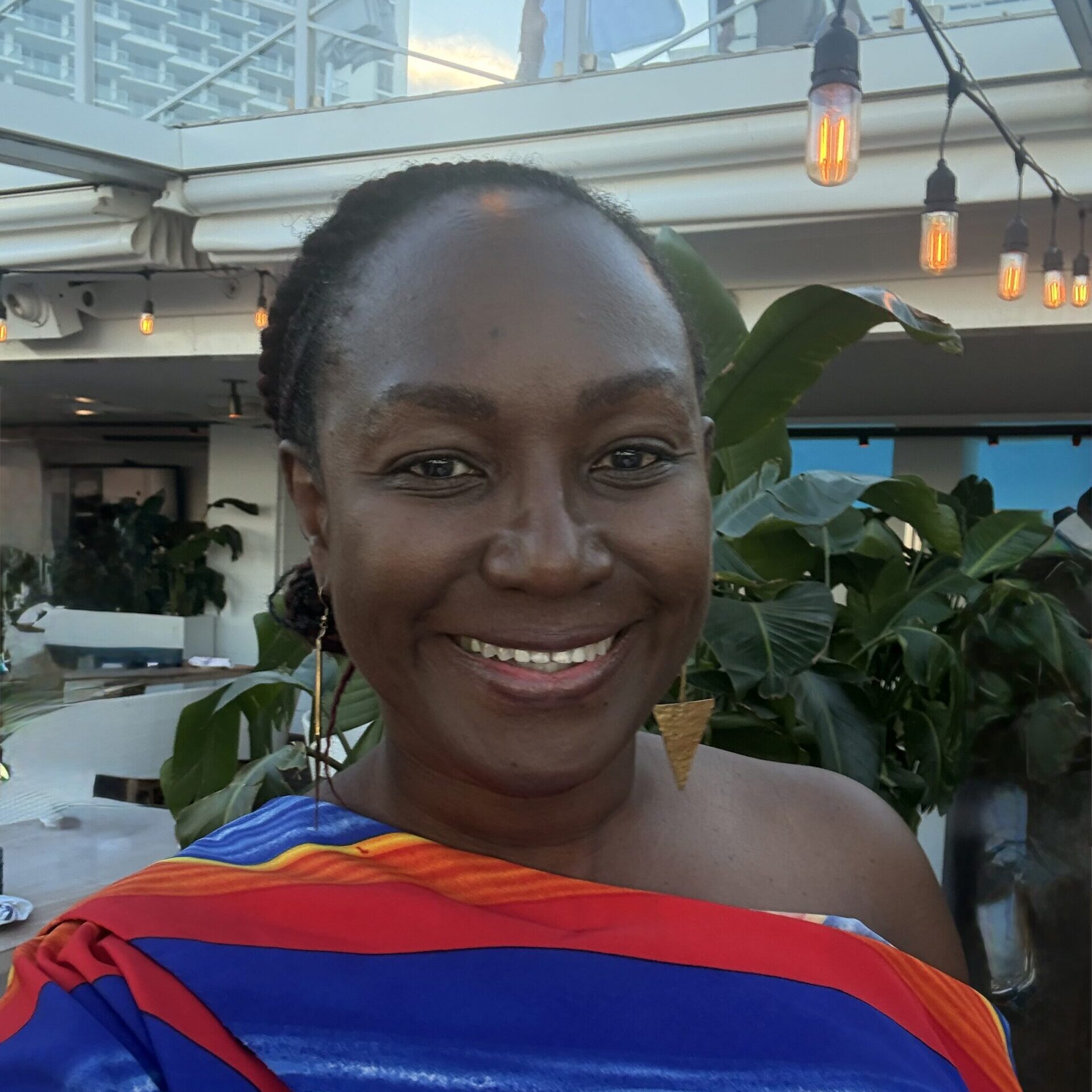
Sophia George is a professor in the Division of Gynecological Oncology at the University of Miami Miller School of Medicine and the principal investigator of the George Lab at the university’s Sylvester Comprehensive Cancer Center.
Transcript of Episode 72: Sophia George
Disclaimer: Transcripts are automated and may contain errors.
Grant Belgard: Welcome to the Bioinformatics CRO Podcast. I’m your host, Grant Belgard. Today we’re joined by Dr. Sophia George, a full professor in the Division of Gynecologic Oncology at the University of Miami’s Miller School of Medicine and a member of the Sylvester Comprehensive Cancer Center. Her lab investigates the genetics and biology of hereditary breast and ovarian cancer and works to close gaps in cancer outcomes across the Caribbean, Africa, and the wider African diaspora. We’ll talk about what her team is doing now, how she got here, and what advice she has for scientists and clinicians working at the intersection of genomics, health equity, and cancer. Dr. George, welcome.
Sophia George: Good morning, hi.
Grant Belgard: Morning. So if you were explaining your lab’s mission to a first-year undergrad, how would you describe the problem you’re trying to solve right now?
Sophia George: Yes, right now is a great question because it has changed a little bit. So what we are ultimately interested in is understanding drivers of cancer and those drivers that lead to more aggressive disease and poor outcomes. And then we take into context what’s surrounding those drivers. So as a molecular geneticist, it’s the only thing about the DNA and sometimes RNA. But now we know that the DNA is not in isolation. Also the RNA is not in isolation and it’s in people. I mean, within cells, within people that are also exposed to factors beyond the genome. And so that’s what we do.
Grant Belgard: What questions are at the top of your list this year and why those?
Sophia George: So questions like, how can we distill spatial and temporal influences on the genome? Meaning spatial, where people are, so geography. And then temporal, how long have they been there? And I’m not thinking thousands of years, but more like tens of years. And how those exposures kind of lead to the signatures that we see, transcriptional signatures that we see in the tissues we’re studying.
Grant Belgard: And what kinds of data are most central for you at the moment? Do you now make transcriptomic, do you now make imaging, clinical, something else?
Sophia George: Yes, everything, everything, which is like, makes us work, makes work very interesting and long, long, long days. So we are looking at epigenetic data using DNA methylation assays, or assays that can tell us about DNA methylation. We’re using epigenomic assays like cut and run and cut and tag. We’re using single cell sequencing assays, transcriptomics specifically, and then spatial assays like COSMX and the APOIA system and a CODEX. And at some point even, I mean, I’m calling names of companies, but that’s how we kind of situate the type of assay and the technology and of course, 10X. So that’s what we use day-to-day in the lab. And then outside the lab in the community, we are also capturing epidemiologic data, survey data, the metadata that’s linked to the individuals that we’re studying the tissues of.
Grant Belgard: What’s a recent result or a signal that genuinely surprised you?
Sophia George: So the more you do, so one of the limitations of the stuff that I do is that one, you have to access the tissue. And of course, clinical data. So part of the metadata is the clinical data. And you’re asking recent, but I would say a while ago, it’s recent in the context of it’s just been put in guidelines. But one of the things that we discovered a while ago is that different populations in the Caribbean have different prevalence of the germline genetic mutations in BRCA1 and BRCA2. And in particular, the Bahamian population have these founder mutations that are really common. So one in four women who have breast cancer or ovarian cancer will have this BRCA1 or BRCA2 mutation specific to that population. The other well-known group are the Ashkenazi Jewish populations or groups. And they have one in 40 people in general, but 10% to 12% who have breast cancer have a mutation in the gene.
Sophia George: So you can hear the differences in these populations. That’s a surprise. So going beyond DNA that you inherit, another thing that we notice is that, at least from the perspective of the work that we’re doing, black women in the Caribbean or people of Caribbean ancestry, and we’ve also noticed there’s, of course, people of West African specifically ancestry. I can’t speak for the entire continent, but I’m speaking from the spaces that I work, have really diagnosed these cancers at a younger age and other populations. Even people with the same BRCA1, not the same identical mutation, but a mutation in BRCA1 and BRCA2. So now it’s collecting samples from all over the world.
Sophia George: We’re seeing that these ancestries with the mutation are a little bit surprising, but it’s good to see it because then we can actually attribute some at least biology, transcriptional biology, tissue biology to the prevalence and the incidence of early age at onset in these populations. So we’re seeing differences in transcriptional profiles that we’ve not yet published, but we’re doing single cell sequencing on hundreds and thousands of tissues from these populations. And so we are starting to see these signals come up, and I’m excited about what the data is going to tell us about the biology.
Grant Belgard: So in ancestry diverse cohorts, what strategies help you separate biology from environment, care access, and other social determinants?
Sophia George: Data, data, data. Really, it’s knowing what you have in the tube and who the people are, where the people are. So it’s putting things in context and why we have to capture that epidemiologic data, the clinical data to discern are we just looking at. I mean, everybody. So for example, I’m studying hereditary breast and ovarian cancer. A lot of my work is focused on the fallopian tubes of people with these BRCA mutations. They have an increased risk of 40% from 27% to like 40% to develop ovarian cancer if you have a BRCA mutation and higher up to 80% you have and for breast cancer. Maybe I’m like skewing the percentages. I think it’s 27% to 60% for ovarian, depending on the gene. OK. So there are other factors that we know are linked to cancer beyond the BRCA. They have an [imputations?] by how many ovulatory cycles or how long women have been ovulating. And that’s the same for breast.
Sophia George: If you have breastfed, if you BMI, increased risk smoking increased risk alcohol consumption. The data keeps telling us how many glasses or no glasses. But nonetheless, alcohol consumption increases your risk. And then a bunch of other things. So when you look at tissue and you isolate the DNA, isolate the RNA, and you’re looking at that signal, then you’re asking, well, for women in West Africa, what age on average do they start having kids? How many kids do they have? The fertility rates are different in the US as even compared to the Caribbean, compared to Africa. So that’s really important to be able to actually see people who are multi-parous. How does a transcriptional profile look compared to people who have one child or no child and no pregnancy or one pregnancy each time that goes to term?
Sophia George: So that is giving us ideas about one just normal physiology of the tissue and then seeing like, well, how can now? So that’s just like normal biology, right? And then we now have the complexity of genomic ancestry, which we know of people in the continent of Africa are the most genetically diverse folks. So we’re not even going down to the single nucleotide polymorphism yet, because we will need tens of thousands. But what we are doing is looking at essentially breaking it down by ethnic groups, self-identified, and also in [?] through the 1000 Genomes Project and others to be able to say, OK, well, people of West Africa, and I’m doing quotation marks, have this signature versus those who are European, or those who are admixed, like in the Caribbean, where we have a little bit of everything.
Sophia George: And one of my PhD students had come up with this logistic regression algorithm and approach to be able to kind of quantify proportion on the amount of African and European ancestry and essentially like a sliding scale and the signature that we see. And so that’s given us an opportunity to be able to disentangle both normal healthy, normal biology of the tissues that we study in the organs and then overlaying that with genomic ancestry. And of course, in the background, I’m determining whether these people have a mutation or not, because that’s also a driver of transcriptional difference.
Grant Belgard: So above and beyond all the biological and social sources of variability, what about the technical sources of variability? Do you think there are issues of collection, fixation, transport, storage, things that you think are currently underappreciated by many people for the impact they have on the downstream analysis?
Sophia George: 1,000 and 20, or maybe 1,200%. That is such a driver. So I should describe a project that we’re doing actively now. We have funding from the Chan Zuckerberg Initiative, where we were funding initially in 2021 to establish the African-Caribbean Single Cell Network. As a proof of concept, can we collect tissues, of course, at the time, snap frozen tissues, single cell tissues that we digest and get single cell suspensions from, I think at the time I started, it was like five or six countries in Africa and the Caribbean and, of course, in Miami. Just the idea of doing that and the premise and collaborating with my peers in those countries and say, do not put things in formalin. And then learning about the process of when tissue gets collected from the OR and taken to pathology and how it gets transported. How long does it sit on the bench? Do we have dry ice? Do we have liquid nitrogen?
Sophia George: That in itself, creating SOPs and changing practice to adapt to collecting tissues that are to be fresh and not just stuck in formalin in writing the OR has been a process on its own that deserves its own one to two, maybe three hour conversation. And you have to do that in each country. And so there is a saturation of the number of samples, right? So instead of saying, well, initially, we’ll digest to 10 and 20. Now we are doing hundreds each country, 400, so that there will be some that fall, right? So you have the outliers. And this is the outlier due to somebody forgot [?] and picked it out. That happens. We can see those added marks. So it takes on training, continuous training of the teams and continuous conversation and monitoring both for tissues and also PBMCs, peripheral blood monocytes, where we started and then we were like, oh, everything is failing.
Sophia George: And it’s because of how long they get kept in the minus 80 or even on the bench, right? So we’ve had to do all of that. And those technical, you can imagine, then over time and in different spaces, you will see these batch effects. So to prevent that from happening and say, we’re sequencing all serially on their own, we have to kind of wait and include samples from different countries in a batch so that when it gets to the lab, whichever lab, they’re trying to decrease the scale of variability.
Grant Belgard: This all sounds very familiar. In my PhD postdoc, we did a lot of postmortem brain work. And yeah, very, very similar challenges. You often don’t have a lot of information on how things were really processed brain bank to brain bank. And in some cases, even within the same brain bank, it will have been processed in very different ways.
Sophia George: Exactly. At the University of Miami, we have several hospitals and clinics where people undergo have to have surgery. So even within our institution, we had to optimize a protocol of transporting samples from the OR to the pathology to the lab. So that would decrease variability within our own health system, because some of them you literally have to drive, like go in a car. Because it’s so far away from the lab, right? It’s not walking distance. So we’ve had to do a lot of optimization.
Grant Belgard: And so if you had unlimited compute, but limited biospecimens, how would you allocate resources across discovery, validation, and mechanistic follow-up?
Sophia George: You’re asking really hard questions. Things that we think about. Okay, so unlimited compute, but limited resources, the tissues. Which is true, which is true, which is a reality. We can’t collect forever. I mean, it would be great to have a saturation of samples and genetic variability. So we would have to do like a test and a validation, right? One of the things that when we decided to scale this project from 15, 15, 15, so 15 fallopian tubes, 15 breasts, 15 prostate samples initially, to now 400, 400, 400, this was to give us room for the technical error, but also hopefully to get to somewhat of a saturation point with the genetic variability. Okay, I know Africa is like completely huge and so much genetic variability.
Sophia George: To test whether if we see something happening in the Ghanaian population and we see differences or similarities in Sierra Leone and in Nigeria because of the geographic proximity. So it would be testing us up, validating another, and then to use, which is something I’m actively thinking about now, use some CRISPR in vitro approach to try to mimic what we’re seeing in the transcriptomics, at least from the single cell perspective. That we still have to go back to modeling. I mean, of course, and I know there’s not like a rambling, but there’s a lot of now in silico things that you can do to mimic like the perturb-seq and all this data, this rich data that’s being generated that we might not need to go into in vitro, but it is always going to be able to say like, these either genetic alterations with this condition is likely increasing risk to develop disease. Can we model this?
Sophia George: And then eventually intercept it somehow, right? Because we know what we think is causing the change. So I would use a lot of tools, artificial intelligence, and generating so much data. Yesterday we saw we had like 1.6 million fallopian tube cells from cells from fallopian tubes just, and that’s only like 85 sample, no, a hundred and something samples, right? So it’s not, and we’re planning on doing this for like 300 to 400 samples per tissue type. And so it’s, we’re going to have a lot of data to inform on what it is that’s happening.
Grant Belgard: Are there computational approaches that you’re excited to scale up or to apply on this really large data set, right? Because oftentimes there are things that in principle people would like to do, but when, you know, you’re looking at data sets that were typical five years ago they just didn’t have the sample size to do it. But with the sample sizes you’re now working or that you’ll be getting, it might open the doors.
Sophia George: Yeah, so I really am excited about working with informaticians who want to use or who are using, I mean, we can’t really avoid it now at different neural networks, LLMs to be able to give us more information and the information, like I already know that my ability to ask questions about the data to look in front of me is limited because I cannot infer the relationships by just looking at it of cells amongst themselves and how the genome is interacting with the transcriptome beyond like the exons, like beyond the exons, right? So how, like, I am excited and I want the data to talk to me and to tell me what is happening. And so I look forward every day. I’m like, okay, what new packages out there?
Sophia George: What new algorithm did somebody come up with to the data that already exists, like in Cell by Gene and Human Cell Atlas, for example, talk to us, like, what is it telling us that I have the limitations of not even being able to ask? So I’m excited about that.
Grant Belgard: When you look at the literature on aggressive breast and gynecologic cancers, where do you see the biggest gaps that bioinformatics could realistically fill in the next five years?
Sophia George: I want more integration of the data. I want more what is happening, which these samples are hard to find, right? But they’re not, they exist. And what is the least amongst, as you asked me before, what is the least amount of data we can put in to be able to infer causality or even a relationship to disease progression? And then of course, on the other side is, well, how do we learn about all the data that we have? What do we learn from it in response to treatments? Knowing that, okay, this genetic signature from this genomic background will likely not respond to like pharmacogenomics and with the transcriptomics will likely not respond to drug X because we have modeled this a thousand times. This we know for sure. These are the questions that I would like answered and with what we already have and all the data that’s been generated like exponentially every day.
Grant Belgard: So when thinking about prevention in hereditary cancers, what does precision prevention look like in practice?
Sophia George: It’s just the old fashioned identify people at risk and then intervene with screening. And of course then there are cooler ways where, so how do you identify? So you could ask how do you identify the person in the first place, right? So how do we identify people who don’t even know that they are at risk or not aware? Yes, mom had breast cancer or ovarian cancer or pancreatic cancer and you think, oh, you know, grandma had that cancer and then you just kind of like, yeah, all people as we age, we get cancer because this cancer is the disease of the aging. Oh, it used to be so. So what tools again, computational tools, can we use to identify these individuals based on the data that they’re putting out there who would benefit from screening, genetic screening? And so that’s the population side.
Sophia George: And then of course the molecular side is of all the data that I’m generating, what are the ways that we can use small molecules to prevent disease?
Grant Belgard: If you had to bet, what’s the most likely near-term translational payoff from your current line of work? You know, is it more risk stratification, earlier detection, therapy selection, something else?
Sophia George: Risk stratification, I’m excited about some things that I brought some folks together to think about in terms of how do we use the data that I’m generating in the real world because they’re real people with real data. And so risk stratification is, you said one, but that’s one on that side. And then there’s a clinical trial that I’m co-principal investigator of where we’re looking at targeted therapy in these populations in three countries, the United States, Nigeria, and the Bahamas to be able to better identify individuals who will respond to these already FDA-approved drugs versus those who would not. I’m excited about that. That’s like long-term because the clinical trial just begun this year, but that’s something that I’m excited about learning.
Grant Belgard: Do you know when that’ll be finished?
Sophia George: Well, it’s a five-year clinical trial. So it just started today, not today, this year, so in five years, but we will be obviously getting data as soon as we see recurrence or response. And of course, you can’t make a conclusion from one person, but it is the fact that we get to do this study and all the components of it, of course, multi-omics and all the fancy things, all the tools, we’re doing all the tools, using all the assays that are available to us now and samples that we banked that we can do things in the future to be able to really go deep in understanding what’s going on. So that’s like a ways away, but in the meantime, it’s a re-stratification and again, integration of all the things that’s what we’re doing.
Grant Belgard: Something to look forward to, yeah.
Sophia George: Yeah, I’m excited. It was like we’ve done a lot of building and now we get to, again, ask really interesting questions and then hopefully have tools to help us resolve things that we don’t even, are not aware of.
Grant Belgard: Yeah, it’s kind of the, you know, biology equivalent to some of these big particle physics experiments, right? It can take a very, very, very long time to get the infrastructure in place and then you run the experiments and get the answers.
Sophia George: Yes.
Grant Belgard: So pivoting now to your own career, what first pulled you towards gynecologic oncology and hereditary cancer research?
Sophia George: Quite honestly, it was, I did a job after my PhD. I did a PhD in molecular genetics, molecular medical genetics and it was on engineering embryonic stem cells and differentiating embryonic stem cells on the cardiovascular system and looking at embryonic development and vascular genesis, angiogenesis. I wanted to do something with humans and I had considered going to medical school. I had applied to go to medical school, I got in and I had just had my son at the end of my PhD and I wanted to take a breather between all those decisions, between making all these decisions and so I applied for a job and I applied for a job to work at a biobank and the person, director of the biobank at the time, she said, but you’re too qualified, you’re overqualified. What is wrong with you? And I was like, I just want a job for a minute just to like not do anything science-y.
Sophia George: And so she offered me equivalent of a postdoc position in her lab and she helped focus, she wanted me to establish cell lines from fallopian tube and [epithelial?] cells from women who were undergoing [risk-reducing?] surgeries because at the time it had just been published and not yet published that the fallopian tubes were a likely site of origin for high rates of ovarian cancer because she’s a pathologist and her scholarship was in hereditary ovarian cancer before it was even a thing like in the context of fallopian tubes. So that’s how I got started. And then the following year, I was always interested, I’m from the Caribbean, I should state, all those listening, wondering where is that accent from. I’m from a tiny island called Dominica in the Caribbean, not Dominican Republic.
Grant Belgard: Dominica is always advertising the citizenship by investment on the planes, right?
Sophia George: Oh my goodness.
Grant Belgard: Every time you fly British Airways or something.
Sophia George: Okay, fine. So I’m from that island. We only have 70,000 people so we can afford to have visitors come. Okay. And so I’ve always been interested in health of the population, mine, I guess, and looking back. And so I got a scholarship to go to school in Canada, did my undergrad, did my PhD at U of T and during my PhD, I got to go to Venezuela with the UN and at the time, the Centre for Bioethics at the University of Toronto. And so I got exposed to thinking about doing genomics in the Caribbean and Latin America. And I had the opportunity to meet people from the Caribbean at the time, got invited to go to the Bahamas and say, oh, by the way, let’s think about genomics in the Caribbean. And I’m working for hereditary- I’m working on a project on hereditary ovarian cancer. And they said, oh, we also have this in Bahamas. And I was like, what do you mean you have BRC in Bahamas?
Sophia George: Like, it’s not a Bahamian thing. It’s a Jewish thing because I was in Toronto and that’s who had the BRCs. And that is how I got really fascinated about our population many years ago.
Grant Belgard: Just geographically, it seems being based in Miami makes a lot of sense. You’re, you know, a short flight or ferry right away.
Sophia George: Exactly. And that is my mentor. So I was in Toronto at the time and my mentor, the person who became my mentor, who was leading the study. So I said to the people when I was in Canada and I’m in the Bahamas. They’re giving a talk. Who is leading this research? And they’re like, oh, someone at the University of Miami and someone in Toronto, Steven Narod and Judith Hurley was at the University of Miami as a medical oncologist. And I got introduced to them. And she is a phenomenal woman who allowed me to ask questions and introduced me to everyone. And now I lead this work, right? But that’s how I got in to studying hereditary ovarian cancer.
Grant Belgard: So speaking of mentors, how did you find mentors and what made those relationships work?
Sophia George: Oh, wow. So Judith was serendipitous, I guess, because as I said, I was in the Bahamas and they said who might I reached out, not necessarily for her to be my mentor, but to see if I could learn more about this study. And she was magnanimous and generous. And I learned so much from her about how to engage with, who do you need to engage with to have impact. There’s always more people, but for sure, the people treating, the doctors treating the patients, you cannot, they’re not, or not to be a bystander in the work, right? Because they’re the ones that are going to see the patients to implement the things that we will eventually find and discover. So she, her personality allowed her to develop into my mentor, to learn and navigate the space.
Sophia George: Pat Shaw, who was my postdoc mentor and lead of the biobank and a pathologist, she ended up being a mentor because she knew so much about the system that we were in and what I was trying to do, quite frankly, as a woman. And it happened to me that I’m a woman of color and not that she was a woman of color, but being a woman in the space, in academia and allowing me to meet her networks and be introduced to them. So I’ve since then identified people that helped me in specific needs, areas of growth. So I tell my folks all the time that I mentor that you can have multiple, and peer mentors are really important. How we can help each other, drive each other, but also again, identifying folks for me who fill a gap and also have some redundancy.
Sophia George: So cheerleaders, supporters, folks who can help me plan and navigate, those have been factors in how I identify folks who might wanna spend time with and learn from.
Grant Belgard: What skills have you found hardest to learn on the job that you wish training programs taught more explicitly? People management, we don’t train the trainees.
Grant Belgard: I think that that is the most common answer I get when asking academics this question, right? Cause you’re promoted cause you’re good at doing science, right? And I guess the assumption is just, you pick up people management on the way.
Sophia George: Yeah, like somehow, right? We know about the DNA, RNA, protein, whatever molecule that we’re studying or trends that if you’re a population scientist, but how do you manage people? I mean, I guess people who do business and other things, they get to learn that.
Grant Belgard: Oh yeah, there are explicit training programs, coaching programs, absolutely, yeah.
Sophia George: Really? No, you learn that, you get to learn that like when you have a lab with people in it already and you’re like, wait a minute, I think I need to learn how to do this. So that, and then budgeting, finance. Although we have people that help us with the finance, but it’s not the same way of conceptualizing how much this project is really going to cost. What are all the factors involved that would cost money? And how do we identify sources of flows beyond and actually being creative about whom you collaborate with and how you do the collaborations. Again, institutions have some of those things, but we don’t get to think about that pre you come into it and then you hope that you find mentors or honest brokers that can let you know that this is happening and that’s an option beyond like thorough funding and how you partner with industry, different types of industry, all those things.
Grant Belgard: Yeah, the budgeting and project management’s a good point. I recall my postdoc advisor had spent some time in management consulting before his MD PhD and he really would use that pretty regularly and it really gave him a leg up in thinking about exactly what you said, what’s the true all in cost of a project, right? Because it’s a lot more than just what you have in the grant and then the time and thinking about recruitment and all that.
Sophia George: I mean, the time, the time, the time, the time. We are on 40 hour week of 60 hour week, whatever the week is, it’s never enough. And especially when you’re doing projects at scale where you are enabling people to lead, you have course when you are at different sites, you have site PIs and they have expectations and so on. But if you’re driving some parts of the science, it takes a lot of time to get everybody on board and a continuous training, all those things are not budgeted for. You know, there’s no line. I’m really, is there a line? Some people are like, yes, I put a line, but that line is never the true line, right? But it’s well worth the efforts of all the things. But yeah, it’s the budgeting, the project management.
Grant Belgard: How have collaborations across institutions or across countries changed the way you do science?
Sophia George: It has changed it significantly. So how? One, different systems, different cultures and practices and how to engage and expectations. Expectations vary independent of the cost. So even if you have a budget, some people want you to be fully involved. Some people want you to be not fully involved. Expectations, not talking about publications, but relationships, like what, how are these relationships built and sustained? They vary by country and they vary by partner, collaborating partner. And so for me, I have projects in, where we, in one region, three different languages. So projects in, oh four actually, Dominican Republic, in Haiti, in Benin Burkina Faso and English. So that’s four languages. And so, and each system, each country is different. And even within country, the institutions are different, different infrastructure.
Sophia George: So, and different questions that they want to ask, different priorities and how they want to ask the questions. So one disease might be more important than another, even within the same organ. And so making sure that, I call them informed believers on board, you have to also acquiesce, which is why collaborations work like the give and the take, or the give and the give, right? What it is that are you fundamentally interested in? Because even if I’m interested in like ovarian cancer, a lot of my collaborators, ovarian cancer is relatively rare compared to other diseases in some parts of the world. So they want to focus on prostate. They want to focus on cervical cancer. They want to focus on some rare disease that only is impacting their population, where I’m interested in the other part of the tissue.
Sophia George: And so how do we ask a robust question scientifically and have everybody, according to COVID, win-win, right? Like always it’s a win-win. So it’s a lot of interplay. And so the science that you see and the science that I’m thinking about is not like linear.
Grant Belgard: What non-technical skills do you find most accelerate progress in community-engaged genomics and in navigating multinational consortia?
Sophia George: One non-technical skills, communication. Communication has been a big, has been an important factor. Humility, I guess, is a behavior. I don’t know if it’s a skill, but it’s necessary. So communicating, being transparent, which facilitates the communication and humility, those things have allowed me to be with my partners on the ground forever, have allowed me to be able to do what I’m doing.
Grant Belgard: If you were advising a PI on setting up a multi-site cohort from scratch, what would you emphasize in governance and quality control?
Sophia George: So governance, setting up a team of folks at individual sites who have been trained and understand the biology enough that the representatives of you versus just managing. And then having harmonized system to collect and track whatever is going on. Like if you’re collecting blood, whatever you’re doing. And of course, optimizing protocols locally. So what protocol you write here or wherever you are is not going to necessarily translate to the T in a different setting that you do not want people to fill in gaps without your knowledge. So it’s like shopping the protocol, workshopping the protocol in each site versus disseminating one protocol and assuming that everybody’s doing the same thing.
Grant Belgard: I feel like that’s pretty universally applicable advice when you try to do anything across different sites in science, outside of science. How do you personally protect time to do deep work?
Sophia George: I block my calendar. So this year I’m interim associate director for the Center for Black Studies at the University of Miami. An interesting year to take up that role, but this is the year. And the center is on another campus. And when I go there, I can be quiet because sometimes nobody knows that I’m there, which is like the best thing. I have to be away from my home often and or my lab office and the lab in a very quiet space. My best work is in the middle of the night, but it’s not sustainable because then I wake up late and I don’t get enough sleep, et cetera, et cetera. Or I wake up early and I don’t get enough sleep when it’s super quiet. So for me, it’s just blocking my calendar and finding peace, like somewhere quiet so that I can think. I can read a paper from beginning to end and think.
Grant Belgard: And what advice would you give your first year PI self?
Sophia George: Oh, Lord, don’t be afraid to pursue the thing that you think is hard. Don’t be afraid. And be bold. Don’t be afraid. Because at once I was considered very timid and shy and sit in the back of the room. And I know that affected my ability to do more sooner.
Grant Belgard: So speaking of being bold, if you could place one big bet in your field and you had to wait 10 years for the readout, what would you fund?
Sophia George: In my field. My field is like, I mean, I’ve developed a few fields. We still, surprisingly, we still don’t have enough people sequenced. Surprisingly, we still don’t know enough between the transcriptome and the DNA, the genome. So, you know, these projects that I’m doing, we need more. We need to get to saturation. So 3,500 single-cell samples from different bodies is not enough. Even if that leads to, I don’t know, 35 trillion cells, I don’t know how many, 10,000, let’s say 10,000 cells, times 3,500, whatever that math is, 35 million. It’s not enough. No, so it’s gonna be three billion cells. It’s not enough. It’s not enough. It’s not even reflective of the number of people in the world. Right. So it’s not enough. It’s not enough. So I would do that. I’ll do more of that. And I would do like deep work, deep.
Sophia George: So the whole human kind of work where you’re not just capturing the single-cell, the RNA, but you’re capturing the epidemiologic data. You’re capturing that metadata that puts context with that piece of tissue or RNA, protein, metabolome, like the molecule, you know, that you, you know, whatever your measure is, that there is significant metadata to make it make sense, to contextualize it. So I would be doing that.
Grant Belgard: I don’t think any of our bioinformatics-interested listeners would disagree with, you know, more data and better metadata, right? Two things people always want.
Sophia George: I mean, it opens the doors to so many, you know, new additional methods and so on that can be used. King and queen. I said king. Metadata is king, but it’s also queen. Like it’s, it’s non-gender. It’s important.
Grant Belgard: So where can our listeners follow your work and your lab’s updates?
Sophia George: Oh boy. So I’m supposed to be updating my website. I post sometimes on Instagram. Sophia HLG and publications. I, yeah, kind of, I know it does, it sounds anticlimactic, right? But yeah, when we travel, we post and of course publications here and seeing the work that we’re doing. Some of it, they all look now and be like, well, this is like all epi stuff, but while we’re building the, and Grant knows and sees the different types of assays that are coming through, it takes time to get these types of rich data and to make, I’m not a, I don’t want to make fast and dirty conclusions. So the metadata and the clinical data is really important to put context with these populations and samples that we’re studying.
Grant Belgard: Thank you so much for joining us today. Really appreciate it.
Sophia George: It’s been fun.
Grant Belgard: Thank you.
Sophia George: Thank you for having me. Thank you.